 Rainy Day Math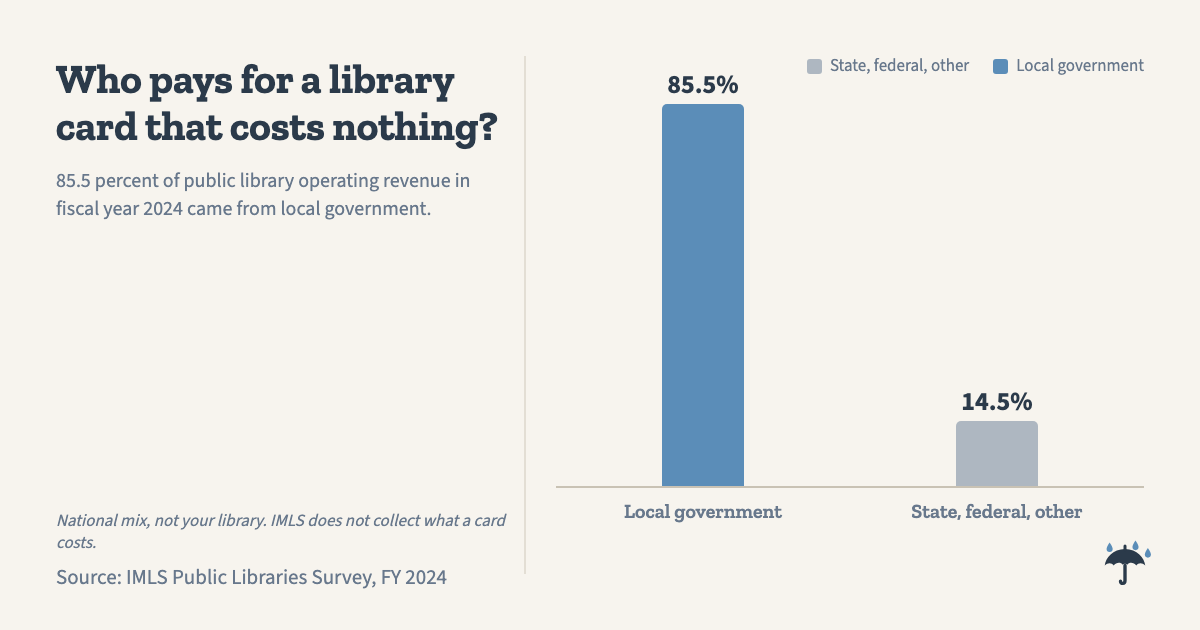
Who pays for a library card that costs nothing?
A library card is one of the few things still in a wallet that often costs what it cost when the holder was ten. The federal survey that counts public libraries does not ask what a card costs. What it does count is who sends the library its operating money.
In fiscal year 2024, local government supplied $15.27 billion of the $17.86 billion public libraries took in to run. That is 85.5 percent. State government sent 6.7 percent. The federal government sent 0.5 percent. The rest, 7.3 percent, is the leftover bucket: gifts, interest, grants, and fees, including any fines or charges for services.
Those dollars come from the Institute of Museum and Library Services Public Libraries Survey, the annual census of public libraries, released in June 2026. The arithmetic is a straight division of the file’s own totals. Anyone with the public-use spreadsheet can repeat it.
the share of public library operating revenue that came from local government in fiscal year 2024. $15.27 billion of $17.86 billion.
Source: IMLS Public Libraries Survey, FY 2024
Who pays for the library if the card is free?
Local government pays for most of it. The survey’s local-revenue line is tax money designated by a city, county, district, or region and available for the library to spend. It does not count donated time, gifts, fines, fees, or grants. Those sit elsewhere on purpose.
That is why a resident card can look like it costs nothing. The bill already ran through the local tax roll. It is also why a card for someone who lives outside the district often does cost something. The American Library Association has said the same thing in plainer language for years: most public library money is local, so many libraries charge people who did not pay that tax.
The 85.5 percent local share is a national mix. A tiny rural library and a big city system are in the same total. The file’s mean local-government revenue across 9,180 libraries is about $1.66 million. The median is $246,286. Those two numbers are far apart because a handful of large systems pull the average up. The share, not the average library’s budget, is the figure to keep.
State money in this file is 6.7 percent, not the round 10 percent that older summaries still quote. Federal money is 0.5 percent, which does match the old “less than 1 percent” line. Neither share is a verdict on whether those governments should send more. They are just the current mix.
Does anyone keep a national price for a library card?
No national office keeps a price for a library card. The Public Libraries Survey counts registered users, visits, hours, circulation, staff, and money in and money out. It does not count the fee on the application. Non-resident fees exist, and some libraries have charged residents too. The $0 at many desks is a local choice sitting on top of that tax mix.
The 7.3 percent “other” bucket is where a card fee would land if a library charged one and reported it as a fee for service. The bucket also holds donations, interest, grants, and overdue fines. There is no way to pull the card-fee slice out.
How many people have a library card?
Public libraries reported 155.3 million registered users in fiscal year 2024, cards on file in their districts, not unique Americans. That is 45.3 percent of the 343.1 million people in those legal service areas.
One person can hold cards from two districts. A file that has not been purged in three years still counts someone who moved away. The survey tells libraries to purge within three years. It cannot see whether they did. The old “two-thirds of Americans have a library card” line comes from opinion polls, not from this count. The two numbers answer different questions, and splicing them makes a cleaner story than the data supports.
The survey’s own frame, from the documentation rather than a sum: 9,200 active public libraries in the 50 states and D.C., with 17,415 outlets (main libraries, branches, bookmobiles). Five systems were temporarily closed and are left out of the tables. Puerto Rico and American Samoa did not complete the year.
Visits in the same file: 869 million. Physical items checked out: 1.42 billion. A registered user is a person with a number on file, not a trip through the door.
Do libraries still charge overdue fines?
Some do. Of the 9,244 libraries that were not temporarily closed, 5,805 said they do not charge overdue fines when print materials come back late, 3,140 said they do, and 299 did not answer. That is 62.8 percent no, as a share of the whole file, and 64.9 percent no among the libraries that answered.
The overdue-fine question is specific. It is about monetary penalties that grow with the days late, on physical print, as of the end of the reporting period. Lost-book bills and the card fee are different lines. A library can abolish overdue fines and still charge a non-resident for a card. A library can keep fines and still issue resident cards at no charge.
The survey counts the cards. It still has no line for the price. The next time the card comes out of the wallet, look up the library’s own card page, and the local budget that pays for the building.
Sources: Institute of Museum and Library Services, Public Libraries Survey Fiscal Year 2024, public-use Administrative Entity file PLS_FY24_AE_pud24i.csv, posted June 2026; Pelczar, Li, Alhassani, and Barr, Data File Documentation and User’s Guide, June 2026, Appendix E (items 300–304, 503, 504) and Appendix G (ODFINE) and Appendix H (revenue and registered-user distributions). Frame counts (9,200 active libraries, 17,415 outlets in the 50 states and D.C.) are from the documentation, page 2. Dollar totals and shares were computed from the public-use file after dropping five temporarily closed systems; the file’s means match Appendix H. ALA’s note on non-resident fees and local tax funding is from the ALA Library Cards libguide, last updated February 19, 2025.