 Rainy Day Math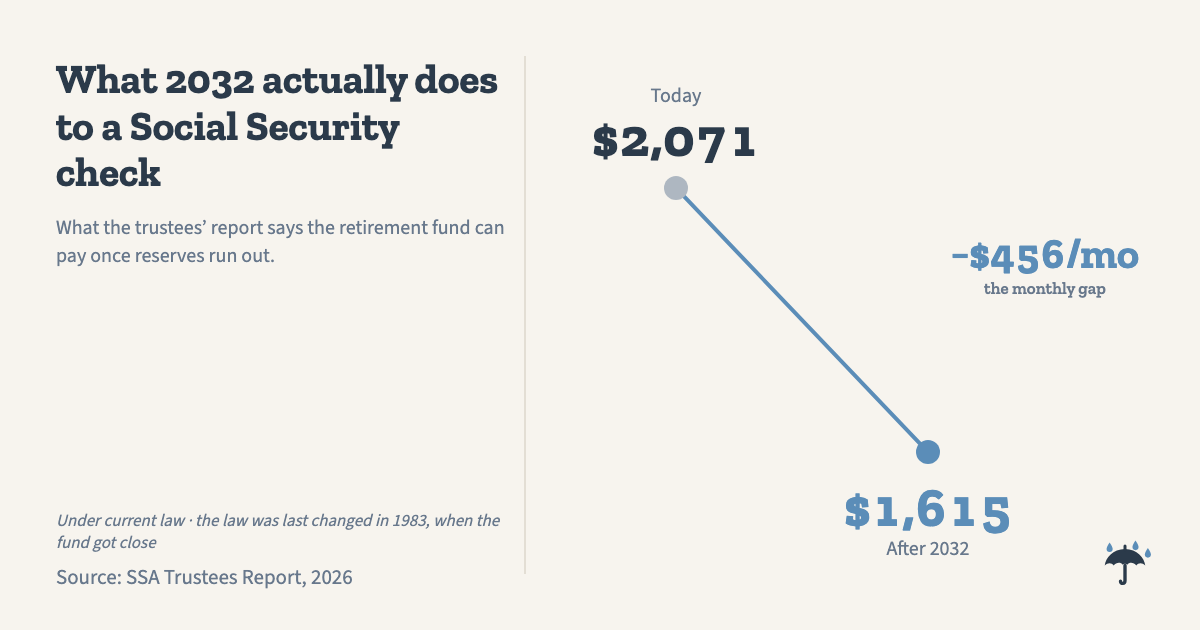
What 2032 actually does to a Social Security check
The government’s own trustees project that Social Security’s retirement trust fund runs dry in the fourth quarter of 2032. That sentence is true, it comes from the 2026 Trustees Report released this June, and it is doing a lot less than most people hear it doing. “Runs dry” does not mean checks stop. It means checks get cut to what incoming taxes can cover, which the same report puts at 78 percent in that first year, sliding lower over the decades that follow.
The gap between those two readings, everything stops versus 78 cents on the dollar, is the gap between panic and a math problem. This article is the math problem.
What the trust fund actually is
Social Security is mostly a pass-through. Payroll taxes come in from people working; benefits go out to people retired; the money barely sits down in between. This is not a flaw someone recently discovered, it is the design, and it has worked that way since the program started paying monthly checks in 1940.
For decades the system collected somewhat more than it paid, and the surplus accumulated in a trust fund. Payroll taxes alone stopped covering the full cost back in 2010. In 2021 the total cost passed the total income even counting the interest the fund earns, which is when the cushion started shrinking rather than growing. The 2032 date is simply the trustees’ estimate of when it is spent.
When the cushion is gone, the payroll tax does not go anywhere. Every paycheck in America keeps generating Social Security revenue the way it always has, and that ongoing stream covers about 78 percent of scheduled benefits. Zero is not on the table under any projection in the report. The honest bad news is a 22 percent cut, arriving on a schedule, unless the law changes first.
The cut, in dollars
Percentages anesthetize. Dollars on the average check:
- Average retired-worker benefit: $2,071 a month (the SSA’s estimate for January 2026, after the 2.8 percent raise)
- 78 percent of that: $1,615.38
- The cut: $455.62 a month, about $5,467 a year
That is the real stake, and it is worth staring at, because $456 a month is not an abstraction to anyone budgeting on $2,071. It is also, and this matters just as much, not zero. Anyone planning around “Social Security won’t exist” is planning around a number that appears nowhere in the government’s own worst-case arithmetic.
Two footnotes on the projections, for precision’s sake. The 2032 figure is for the retirement fund (OASI) on its own. You will also see 2034 and 83 percent quoted; that version treats the retirement fund and the separate, healthier disability fund as one combined pool. The trustees’ own summary says the two “could not actually be combined unless there were a change in the law.” And these dates move: last year’s report put depletion in the first quarter of 2033, and this year’s moved it one quarter earlier. Treat the date as a moving estimate with a firm neighborhood, not an appointment.
the cut on an average check if the fund runs dry in 2032 and Congress has not acted first. Smaller, not zero.
Source: 2026 OASDI Trustees Report
The precedent, minus the politics
This has happened before, almost exactly. In the early 1980s the trust fund came within months of the same kind of depletion. In 1983, Congress passed a package of fixes, signed by President Reagan after a commission led by Alan Greenspan, and the deadline dissolved. That is not a prediction that it goes the same way this time. It is just the one directly comparable episode on record, and in it, the law moved before the cut did.
That release is worth a calendar note, honestly. It has landed in June the last two years, though it came in May in 2024 and March in 2023, so it is a season rather than a date. One page of it, the summary table, tells you whether the estimate moved. It has moved before. It will move again, one direction or the other, and you will know within a day of the actuaries.
Sources: 2026 OASDI Trustees Report, released June 9, 2026 (OASI depletion fourth quarter of 2032, 78% of scheduled benefits payable at depletion and declining to 62% by 2100; combined OASDI, shown on a combined basis: third quarter of 2034, 83% payable, declining to 65%); Social Security Administration, 2026 COLA fact sheet, estimated average retired-worker benefit payable January 2026 ($2,071). Dollar figures are that average times the report’s payable share, in today’s dollars rather than 2032 dollars.