 Rainy Day Math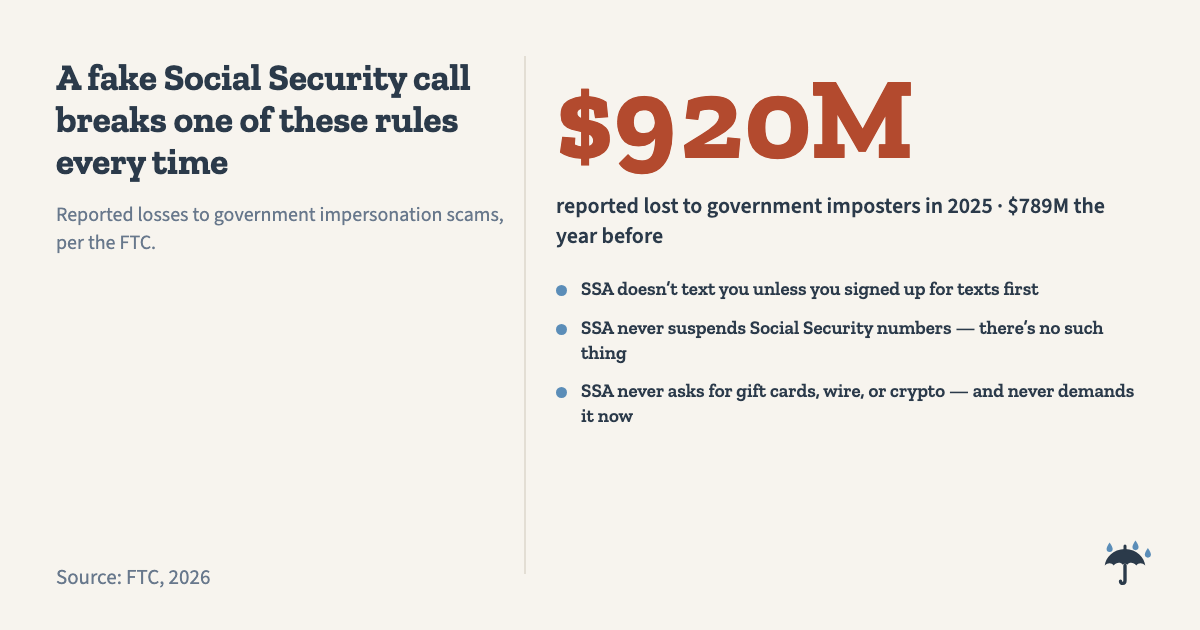
A fake Social Security call breaks one of these rules every time
In 2025, Americans reported about $920 million in losses to people impersonating the government, up from $789 million the year before. That figure is the Federal Trade Commission’s, and it only counts what got reported. The Social Security Administration’s own inspector general put out an alert in July 2025 telling people to treat an unexpected call, text, email, or letter as a scam first, and another in February 2026 about fake emails dressed up as your Social Security Statement.
The reason this scam works is that the caller sounds official and the threat sounds plausible. The reason it can be beaten is simpler than most people expect: the real SSA operates under rules it does not break, and a scammer cannot make money without breaking one of them.
reported lost to government impersonators in 2025, up from $789M the year before.
Source: FTC, 2025
The rules
These come from the SSA and its Office of the Inspector General, not from us:
- The SSA will never demand payment by gift card, wire transfer, or cryptocurrency. There is no version of a real government debt that gets settled at a grocery store gift-card rack.
- The SSA will never threaten to suspend your Social Security number. Suspended SSNs are not a thing. The number cannot be suspended, frozen, or revoked by a phone call.
- The SSA will never demand immediate payment. Real agency business typically moves by mail, gives you time, and survives you hanging up and calling back.
- The SSA only texts people who have opted in to texts. An out-of-nowhere text about a problem with your benefits is out of the running before you read the second sentence.
Notice what the list keys on. It is not the caller ID, which can be faked to display the SSA’s real number, and it is not the person’s tone, which is often calm and professional now that the good scripts have stopped sounding desperate. The rules key on what the caller wants you to do, and that part the scammer cannot disguise. The whole enterprise exists to move your money somewhere unrecoverable, quickly. Gift cards, wire, crypto, urgency. Strip those out and there is no scam left.
Why “the SSA never calls” is not the rule
One correction to the version of this advice that floats around: the SSA does make phone calls. If you have ongoing business with them, an application in progress, a question you asked, they may well call you. So “a call from Social Security is always fake” is not quite true, and a checklist built on it will eventually misfire in both directions.
The durable test is the ask, and that framing is our read rather than a rule the SSA publishes. A real SSA employee on a real call will not mind if you hang up and call back through the main number, 1-800-772-1213. A scammer minds a great deal, because the callback destroys the script. Urgency is what makes the crime work, not a mood the caller happens to be in. The pressure to act right now, before you talk to your daughter or your bank, is exactly what the script is counting on.
The clean move, any time a government call raises your pulse: hang up, look the agency’s number up yourself, and call it, using the number printed on ssa.gov or on paper mail you already had rather than anything the caller offers. If the problem is real, it will still be there when you call the main line yourself. With these calls, it never has been.
What this list cannot do
The FBI’s Internet Crime Complaint Center counted $7.75 billion reported lost by Americans 60 and over in 2025, across the internet-enabled crimes people report to it, with an average loss of $38,500. That average is a plain arithmetic mean, pulled upward by the 12,444 people who each lost more than $100,000, and the FBI does not publish a middle figure. Even so, losses in that range mean retirement savings rather than pocket money. People who fall for this are not foolish. They are polite, they respect authority, and they were raised to take an official call seriously, which is precisely the instinct the script is engineered to use. The defense is knowing the four rules and letting the callback do the work.
If a call like this has already cost you or someone in your family money, the report goes to oig.ssa.gov and reportfraud.ftc.gov. Reporting does not always get the money back, but it feeds the alerts that warn the next person.
Sources: Federal Trade Commission, “FTC Data Show People Reported Losing $3.5 Billion to Imposter Scams in 2025,” June 15, 2026 (about $920M to government impersonators, up from $789M in 2024); Social Security Administration, “What should I do if I receive a call from someone claiming to be a Social Security employee?” (FAQ KA-10018, updated December 11, 2024), which is also the source for the SSA calling people who have business in progress; SSA Office of the Inspector General scam alerts, July 31, 2025 and February 19, 2026; ssa.gov/scam; SSA national number and hours from ssa.gov/agency/contact; FBI, 2025 IC3 Annual Report, elder-fraud section ($7.748B and 201,266 complaints from people 60 and over).