 Rainy Day Math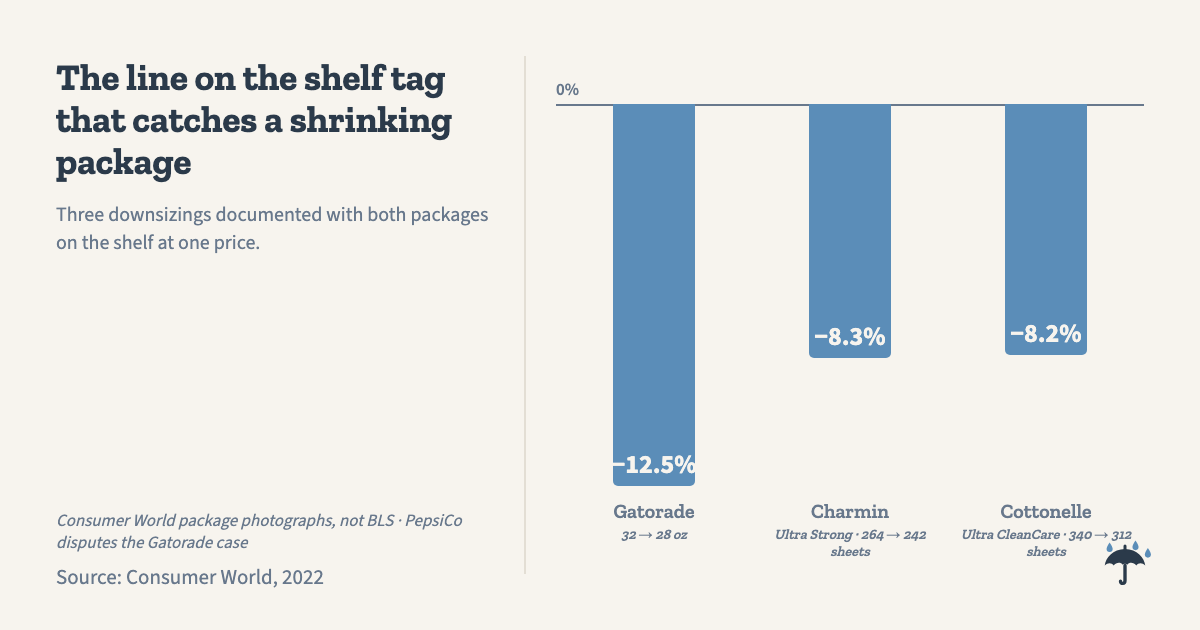
The line on the shelf tag that catches a shrinking package
In 2022, the words “Family Size” moved. Post took them off its 23-ounce box of Honey Bunches of Oats, put them on an 18-ounce box, and renamed the old one “Giant Size.” Both boxes are still out there. A shopper who buys by the words instead of the ounces goes home with 21.7 percent less cereal and saves about a dime. Nobody announced it, because nothing about it has to be announced. Changing the package, or just the name on it, is legal, it is common, and the label stating the weight is technically right there, in the corner, in the type nobody reads.
The practice has a nickname now, shrinkflation, but it is older than the nickname and it is not a conspiracy theory. It is a pricing decision with a paper trail, and this article is about where the paper trail is: once in the government’s inflation data, and once on the shelf edge in front of you.
Yes, the government counts it
A thing people assume: that shrinking a package is a loophole, a way to raise prices without it showing up in inflation statistics. It is a reasonable guess and it is wrong. The Bureau of Labor Statistics prices items per unit, per ounce, per sheet. When a package shrinks and the price holds, the price per ounce went up, and the BLS records exactly that as a price increase. Its own published example: a roll that drops from 220 sheets to 200 while the price stays put gets logged as a 10 percent increase in the price per sheet. The agency also maintains a research series that isolates how much downsizing contributes on its own.
So the inflation number already contains the shrink, and it also says the effect is small. The Government Accountability Office looked at 2019 through 2024 and found downsizing added less than a tenth of a percentage point to the 34.5 percent that consumer prices rose overall. That is small across the whole basket and much bigger in the aisles where it concentrates, where the GAO put it at 3.0 percentage points for household paper products, 2.6 for snacks, 2.3 for candy and gum, 1.8 for ice cream, and 1.6 for breakfast cereal. What the inflation number cannot do is stand next to you at the shelf. For that there is a much older tool.
how much package downsizing added to household paper prices from 2019 to 2024, the aisle where it concentrates most.
Source: GAO, 2025
The unit price line
Look at the shelf tag. The big number is the price. Somewhere near it, smaller, is a second number: the price per ounce, per quart, per 100 count. It is not guaranteed to be there. Sixteen states, the District of Columbia, and two territories require unit pricing by law, and everywhere else it is the store’s choice, though most chains print it anyway. That line is the whole defense. A package can shrink, a box can gain a “NEW LOOK!” banner, a bottle can get a fresh contour that hides two missing ounces. The unit price does not care. It divides the price by what is actually inside, which is the one operation the packaging cannot dress up.
Comparing two brands? Compare the unit price, not the shelf price. Suspicious that your usual brand got lighter? The unit price is where it shows first. That is the entire technique, and it does not require remembering what anything used to weigh.
It is not a clean tool, and the government says so. The weights-and-measures people at NIST told the GAO that stores use different units for similar products, in small type, in inconsistent spots on the tag, which makes comparing harder than it ought to be. Worth knowing before you go looking and find the tag beside the peanut butter measured one way and the tag beside the jelly measured another.
The receipts, by name
Almost none of these are announced. They get caught by shoppers who photograph the old package beside the new one (Consumer World has been running that operation for about thirty years) and by analysts comparing archived store listings. Three that were documented with both packages on the shelf at the same price, in the same store, on the same day:
| Product | Was | Now | Documented |
|---|---|---|---|
| Gatorade bottle | 32 oz | 28 oz (−12.5%) | March 2022, both $1.09 |
| Charmin Ultra Strong Mega roll | 264 sheets | 242 sheets (−8.3%) | September 2022, both $14.29 |
| Cottonelle Ultra CleanCare Strong mega roll | 340 sheets | 312 sheets (−8.2%) | March 2022 |
And one caught a different way, by comparing four years of a retailer’s own listings: family-size Frosted Flakes went from 24 ounces to 21.7 (−9.6%), which worked out to a 40 percent increase in the price per ounce.
Toilet paper deserves its own mention because it is the category where the practice approaches an art form. Sheet counts drift downward roll by roll while the packaging invents new size vocabulary, Mega, Super Mega, each one bigger-sounding than the last and none of them a stable unit of anything. There is no such thing as remembering what a Mega roll should hold. There is only the per-sheet math, and the shelf tag does it for you.
Next trip, pick one item you buy every week and read its unit price. Not to catch anyone. Just so the number is in your head the day the package changes shape.
Sources: U.S. Bureau of Labor Statistics, “Getting less for the same price? Explore how the CPI measures ‘shrinkflation’ and its impact on inflation,” Beyond the Numbers vol. 12 no. 2, February 2023 (bls.gov/opub/btn/volume-12/measuring-shrinkflation-and-its-impact-on-inflation.htm); BLS, “Research CPI without product size changes (R-CPI-SC)” (bls.gov/cpi/research-series/r-cpi-sc.htm); U.S. Government Accountability Office, “Consumer Prices: Trends and Policy Options Related to Shrinking Product Sizes,” GAO-25-107451, released July 31, 2025 (gao.gov/products/gao-25-107451), which is also the source for the count of states requiring unit pricing and for the NIST comments on tag legibility. Package changes documented by Consumer World / Mouse Print (March and September 2022) and the LendingTree shrinkflation study of September 30, 2024. No manufacturer confirmed any of them.